

Essay
The Delegation Feedback Loop
You didn't get dumber. You got comfortable. Here's the mechanism, and the way back.
Listen
Side A — The Read
This recording may be out of date. The text was edited after this audio was recorded.
About this recording
- Nature
- Human-recorded speech, not synthetic
- Recorded by
- Micah Eberman, using QuickTime Player
- Source text
- The Delegation Feedback Loop, written by Micah Eberman
- Recorded on
- Reviewed by
- Micah Eberman,
- Owner
- Micah Eberman
About this recording
- Nature
- Human-recorded speech, not synthetic
- Recorded by
- Micah Eberman, using QuickTime Player
- Source text
- The Delegation Feedback Loop, written by Micah Eberman
- Recorded on
- Reviewed by
- Micah Eberman,
- Owner
- Micah Eberman
The text on this page is the transcript of this reading.
Watch
Loads the YouTube player and starts the video. Contacts youtube-nocookie.com, a third party. Nothing is sent until you press play. Or watch it on YouTube instead.
Read
Essay briefing
The claim: you didn’t get dumber, you got comfortable — every time a tool earns a little more trust, the bar for what you’ll hand it next drops a little further, and the two feed each other until the judgment you used to exercise on your own is a muscle you can’t flex on command anymore. This essay makes that case in six moves: first, the delegation feedback loop itself, the plain mechanism where climbing trust and dropping delegation turn in a circle that only ever spins one way; second, the 2026 research that turned this from a hunch into a finding, from Wharton’s efficiency trap to the MIT Media Lab study that measured cognitive debt directly; third, why the industry’s own throughput scoreboard is structurally blind to this cost, priced by output and never by what happened to the operator; fourth, the tired human test, the standard of whether a tool still serves you when you’re empty rather than only when you’re at your best; fifth, the difference between load you can hand off without loss and judgment you have to keep, an AI that plays the drums for you versus one that holds the metronome so you can find the pocket; and sixth, what to actually change starting Monday. Reading time: about six minutes.
Try to remember the last phone number you memorized.
Not looked up. Not tapped from a list of favorites. Memorized. Held in your own head because you needed it and no machine was going to hold it for you. For most of us the honest answer is a number from fifteen or twenty years ago, and that’s not an accident. Somewhere along the line the contacts app got good enough that keeping numbers in your head went from normal, to quaint, to why would you even bother. Nobody took the skill from you. You set it down. It was heavy, something offered to carry it, and you let go.
That handoff felt like a win. It was a win.
It’s also the exact shape of the thing now happening to your judgment.
The loop, said plain
Section 1 of 6.Here is the mechanism, and it’s almost embarrassingly simple. The more you trust the tool, the lower the bar at which you hand it the next thing. And every handoff you don’t regret raises your trust a little more. Trust climbs, the line for what you’ll delegate drops, and the two feed each other in a circle that only ever turns one way.
Call it the delegation feedback loop.
The first draft you let the machine write, you read like a hawk. The tenth, you skim. By the fiftieth you’re waving through work in a field where you used to be the one people asked, and you’re waving it through faster than you could have made it and slower than you could have checked it. That middle ground, too quick to verify and too smooth to question, is where the loop lives. It never announces itself. Nobody wakes up and decides to stop thinking. You just keep accepting slightly better help at a slightly lower level of attention, one reasonable call at a time, until the muscle you were renting out is a muscle you can’t flex on command anymore.
That’s the part the productivity story never puts on the invoice: the efficiency was real, the cost was real, and they were the same transaction.
None of this is new-age hand-wringing. Human-factors researchers mapped the failure decades before anyone typed a prompt. Automation gets overtrusted until people stop really watching it, a pattern they flatly labeled misuse. And hand a person full automation and their grip on the situation quietly decays until they can’t step back in when it finally matters. They named that one the out-of-the-loop problem, and its cruelest detail is that it bites hardest exactly when the automation is most complete.
This stopped being a hunch
Section 2 of 6.For a couple of years this was a feeling. A thing writers and knowledge workers muttered about at the edges of the group chat. In 2026 it stopped being a feeling and started being a finding.
The research landing this summer is blunt. Workers report feeling less capable of independent judgment even in areas where they used to be the expert, and the drop in personal agency tracks almost exactly with the rise in how much they trust the AI. Wharton’s people call it an efficiency trap: gains that curdle into a treadmill, where the speed you bought becomes the speed you now owe. The American Psychological Association gave its summer issue to how these tools are reshaping the actual skills underneath the work. A run of new papers put a number on the quiet part: hand someone an AI crutch and their persistence drops, their independent scores drop, they quit sooner when you take the crutch away. One MIT Media Lab team wired up 54 people writing essays and watched the group leaning on the chatbot post the weakest connectivity across the brain, report the least ownership of what they’d written, and then fail to quote their own sentences back. They called it cognitive debt.
Even Microsoft retitled its 2026 Work Trend Index around human agency. When the company selling you the agents leads with “careful you don’t lose yourself to the agents,” the tell is loud.
Set that on top of what we already knew about the shape of the day. The average knowledge worker toggles between apps and contexts something like 1,200 times a day. It takes roughly 23 minutes to climb all the way back into deep focus after a single interruption. Close to 40 percent of our productive capacity goes not to the work but to the machinery of switching between work. We never had a thinking-speed problem. We had a fragmentation problem, and we bought a stack of tools that made the fragments arrive faster.
Why the scoreboard can’t see it
Section 3 of 6.Here’s the uncomfortable turn. By every number the industry actually keeps, the delegation feedback loop reads as a success.
The reigning way to measure AI at work is throughput: cost per successful task, time to completion, tasks closed per head. One of the big labs just proposed a “scorecard for the AI age” built on exactly that, useful work and cost per successful task and dependability and return on compute. It’s a good scorecard. For the machine.
Not one line on it measures what the interaction did to the person on the other side of it. Did they walk away sharper or duller. More able to do it alone next time, or less. Did the tool leave a capable human behind, or a dependent one. The scoreboard is silent, because the scoreboard was built to price the output, never the operator. And a cost your metric can’t see doesn’t stop existing. It just stops getting counted, and compounds off the books, until it turns up as a person who can no longer do the thing they’re paid to judge.
When Anthropic’s own researchers ran the experiment instead of assuming the answer, the shape of it came out clean. Developers who leaned on AI to write code finished only a hair faster, and scored about 17 percent lower when they were quizzed on how their own code actually worked. Close to two letter grades. The throughput ticked up. The understanding fell out the bottom, and there was no line on the scoreboard pointed at the understanding.
You can’t manage what you refuse to measure. Something like 95 percent of enterprise AI pilots fail to scale, and the post-mortems keep pointing at models and integrations. They might try pointing here: at tools tuned to win a number that was never the point.
The tired human test
Section 4 of 6.So here’s the test I hold every tool up against, and the one most of them fail.
The tired human test: does this still serve you when you’re empty? Not the demo version of you, rested and sharp and running it for the first time with your whole attention on it. The real one. End of the day, third fire, half a tank, the version of you who will accept whatever gets put in front of them because summoning the will to push back costs more than you’ve got left in the drawer.
Most AI tools are designed for the first human and shipped to the second. They’re most persuasive right when your guard is lowest, and they ask for your approval right when you’re least equipped to give a real one. A tool that only helps when you’re already at your best isn’t help. It’s a fair-weather friend.
A tool that passes the test does the opposite. It carries more of the load exactly as your own capacity dips, but it carries the load you can’t, not the load you shouldn’t have set down. It holds the twelve open tabs of context so your head doesn’t have to. It protects the decision that’s yours to make instead of quietly making it for you. That line, between the weight that’s crushing you and the judgment that was always yours, is the whole game.
Think with, not for
Section 5 of 6.I keep coming back to one line, and it keeps earning its place:
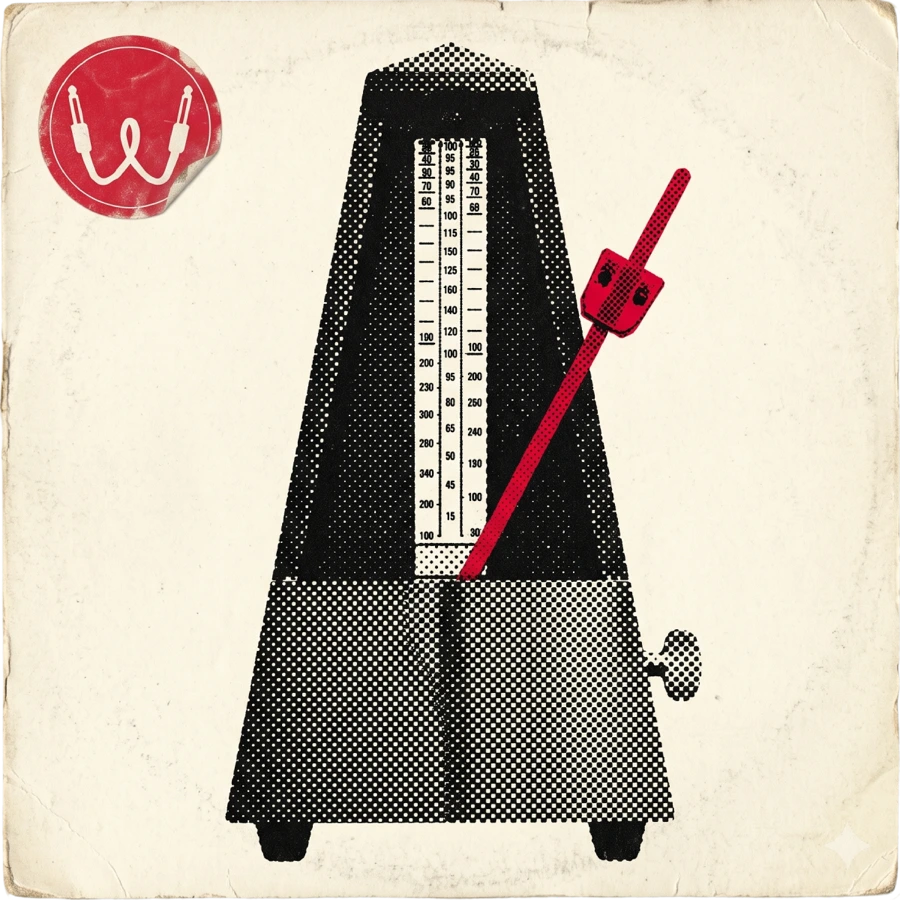
I don’t want an AI that plays the drums for me. I want an AI that holds the metronome so I can find the pocket.
An AI that plays the drums for you makes a track. It also makes a drummer who’s slowly forgetting how to keep time. An AI that holds the metronome does something quieter and worth far more: it takes the one thing you can hand off without loss, the steadiness, the structure, the count you were never going to improve by sweating over it, and it gives you back the part that was always the point. The feel. The choice. The pocket.
That’s what I mean by authored intelligence. Not intelligence that authors for you. Intelligence you stay the author of. The machine can hold the pen dead steady. The words have to stay yours, or they were never worth the ink.
There’s a version of this technology that runs the loop backward. Patient instead of loud. Ambient instead of demanding. Built to grow your capacity rather than quietly stand in for it, so that every pass leaves you a little more able to do it alone, not a little less. Measured by how much stronger it left the human, not by how much of the human it managed to replace. It’s harder to build. It’s harder to sell, because “makes you better, slowly” will never out-shout “does it for you, now.” But it’s the only version that doesn’t end in a room full of experts who can’t remember how to be experts.
That’s the work I’m building toward. More on the how before long.
What to do Monday
Section 6 of 6.You don’t have to wait on anyone to ship anything. The loop runs on your defaults, so move the defaults.
Notice the skim. The second you catch yourself waving through work you’d normally check, that’s the loop tightening. Stop and actually check one. Not all of them, one. Keep the muscle warm.
Delegate the load, keep the call. Let the machine hold context, drafts, structure, the tab-juggling. Keep the decisions that need you to have understood the reasoning. If you can’t say why the output is right, you didn’t delegate a task, you delegated a judgment.
Run the tired human test on your own shelf. Look hard at the tools you lean on when you’re fried. Are they leaving depleted-you sharper, or just more agreeable? Cut the fair-weather friends.
You didn’t get dumber. You got comfortable, one reasonable handoff at a time. The good news about a loop is that it has a direction, and a direction can be turned around. The trick is to keep hold of the pen.
Sources
- Knowledge at Wharton, “The AI Efficiency Trap: When Productivity Tools Create Perpetual Pressure” (2026). The treadmill, learned technological helplessness, and personal agency dropping as AI trust climbs. knowledge.wharton.upenn.edu
- American Psychological Association, “How AI is reshaping human skills and thinking,” Monitor on Psychology (July/August 2026). apa.org
- Rohan Narayana Murty et al., “How Much Time and Energy Do We Waste Toggling Between Applications?” Harvard Business Review (August 2022). The roughly 1,200 app switches a day, measured across Fortune 500 workers. hbr.org
- American Psychological Association, “Multitasking: Switching costs” (Meyer, Evans, and Rubinstein). Task switching can eat as much as 40% of productive time. apa.org
- Gloria Mark, Attention Span (2023), University of California, Irvine. The widely cited finding that it takes roughly 23 minutes to fully resume a task after an interruption. ics.uci.edu
- MIT NANDA, “The GenAI Divide: State of AI in Business 2025.” Roughly 95% of enterprise generative AI pilots show no measurable impact on the P&L. Fortune coverage
- Nataliya Kosmyna et al., MIT Media Lab, “Your Brain on ChatGPT: Accumulation of Cognitive Debt when Using an AI Assistant for Essay Writing” (2025). EEG across 54 participants; the group leaning on the LLM showed the weakest neural connectivity and the lowest ownership of their own writing. media.mit.edu · arXiv
- J. H. Shen and Alex Tamkin (Anthropic), “How AI Impacts Skill Formation” (2026). A controlled study: developers using AI scored roughly 17% lower on a comprehension check, about two letter grades, despite finishing only marginally faster. arXiv · summary
- The human-factors literature on automation, on overtrust and the out-of-the-loop problem: Raja Parasuraman and Victor Riley, “Humans and Automation: Use, Misuse, Disuse, Abuse,” Human Factors 39(2):230-253 (1997), journals.sagepub.com; and Mica Endsley and Esin Kiris, “The Out-of-the-Loop Performance Problem and Level of Control in Automation,” Human Factors 37(2):381-394 (1995), journals.sagepub.com.
Additional context on the “scorecard for the AI age” framing: OpenAI, “A scorecard for the AI age” (2026), openai.com.
Liner Notes
The soundtrack to this essay
Welcome to my life. The keys lost three times this week, barely staying alive, fried executive-function human anthem this whole essay is, in part, written to. High-five to my fellow neurodivergent gathered here to...wait...The Afghan Whigs have a new single out?! Hold on...what were we discussing?
Here the loop is tightening. The feel of the grip on the situation quietly decaying until you can't step back in...the out-of-the-loop problem set to a bassline. Control isn't taken; it slips, one handoff at a time. Reminds me of the saying...trust is gained in drips, but lost in buckets.
The tired human. "I'd give you everything I've got for a little peace of mind." Third fire, half a tank...the version of you these tools are built to persuade, right when your guard is lowest.
And the card flips on the turn. A flat, mechanical insistence...control, I'm here...the moment you take the call back. Delegate the load, keep the judgment. If you can't say why the output's right, you delegated a judgment, not a task. Let's try to avoid that, shall we?
The way back down the river. "It's hard to dance with a devil on your back." A loop has a direction, and a direction can be reversed. You didn't get dumber...you got comfortable. Shake it out.